
Recycling is often discussed in terms of materials and metrics. But behind every sorting line and every recovered tonne lies a combination of strategic investment, operational discipline, and genuine conviction. Hamburger Recycling Hungary (HRH), part of the Prinzhorn Group, represents exactly that combination. With a newly commissioned optical sorting line at its Csepel facility and a clear strategic direction for the years ahead, the company is reinforcing its position as one of Hungary's most significant players in paper waste processing and recycling.
We sat down with Mária Karczub, the Managing Director of Hamburger Recycling Hungary to discuss what this moment means for the company, how she sees the Hungarian recycling landscape evolving, and why she believes the circular economy is ultimately a people story as much as a technology story.
A Career Shaped by Conviction
Not everyone arrives in the recycling industry by design. For the Ms Karczub, the entry point was, in her own words, partly chance. What was not chance was staying.
"The world of recycling quickly draws you in. Once you get a taste of it, it is hard to let go."
After joining a company in paper recycling and processing, Mária Karczub found herself genuinely captivated by the complexity of the field. That sustained professional engagement did not go unnoticed. When the time came to appoint a new Managing Director for HRH, Management turned to someone whose commitment had been consistent and clear.
Mária’s leadership philosophy reflects that same consistency. She describes her approach as one of steady direction combined with genuine adaptability: clear goals, transparent communication, and an openness to the technological and regulatory shifts that define this industry. In a sector where market conditions, policy frameworks, and collection quality can all change simultaneously, that kind of equilibrium is not incidental. It is a deliberate posture.
The Csepel Investment: Precision at Scale
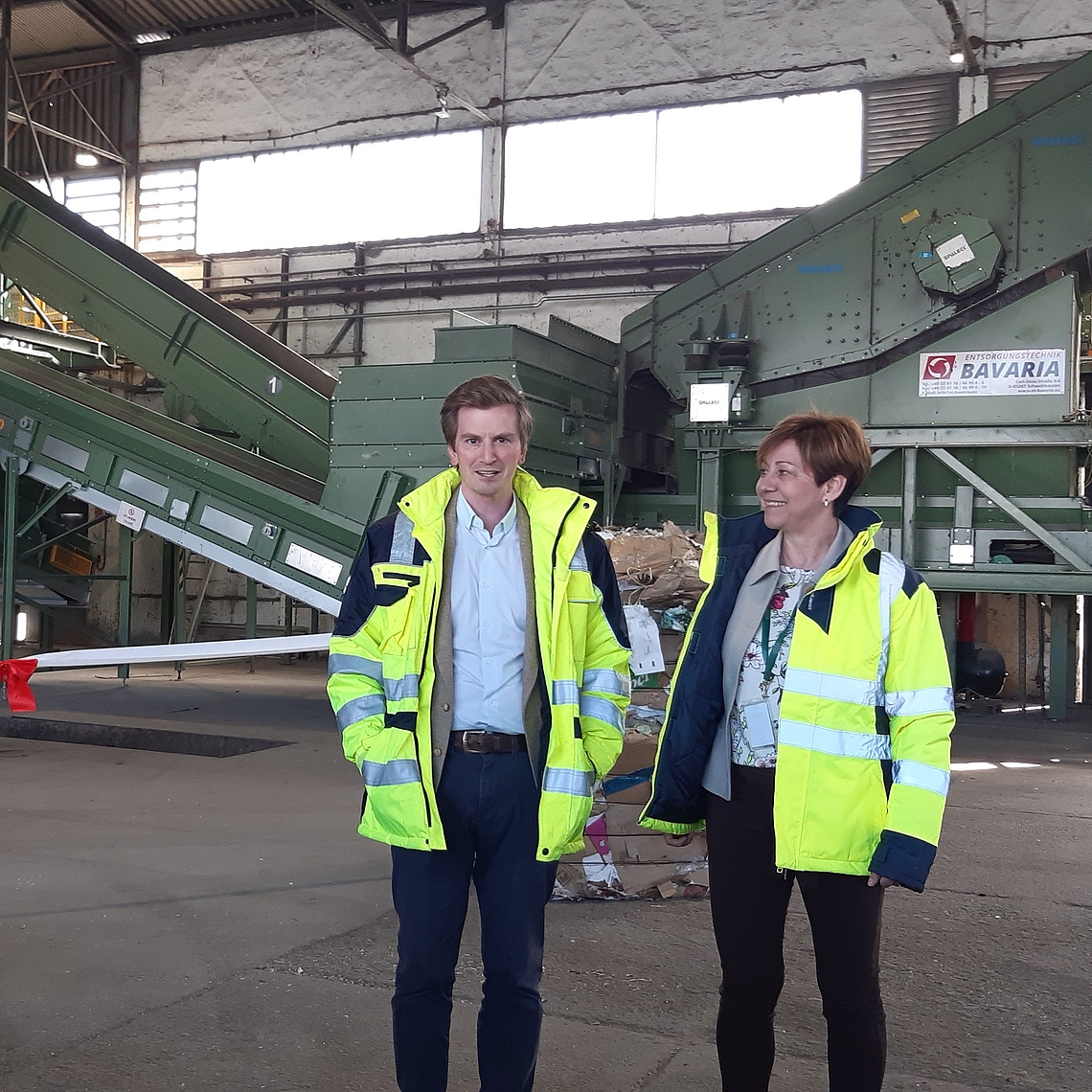
The most visible recent development at HRH is the commissioning of a new optical sorting line at its Csepel site, a facility that has long been central to waste processing in the Budapest region. The investment is significant not only in scale but in what it enables.
What are the most significant improvements this new technology brings compared to the previous system?
"The optical sorting unit significantly increases the volume of waste that can pass through the line, while providing more accurate material recognition and therefore more efficient separation. As a result, we can produce cleaner fractions of more stable quality for recycling."
The implications extend beyond throughput. Higher-quality secondary raw materials mean a stronger value proposition in the market for recovered materials, a market that rewards consistency. More precise separation reduces losses, which in turn reduces operating costs and increases the share of material that can genuinely re-enter the circular economy.
But the Managing Director of HRH is clear that technology is a multiplier, not a standalone solution. The quality of input material, determined largely by how households and businesses collect waste, remains the binding constraint.
"The cleaner and more consistently households separate waste, the more efficiently we can operate and the higher the recoverable volume will be."
This connection between upstream behavior and downstream performance is a thread that runs through her thinking on the industry as a whole. Technology raises the ceiling; collection quality determines how close the system gets to it.
The Hungarian Recycling Landscape: Progress and Persistent Gaps
Hungary's recycling system has developed considerably in recent years. But progress has not been uniform, and the gap between collection volumes and consistently high-quality output remains a defining challenge.
Where do you see the biggest opportunities for improvement in the system?
"I see the biggest opportunities in improving collection quality and making the system more predictable, so that fewer unsuitable items end up in separate collection and it is clearer what goes where. It is also important to ensure a stable market, including domestic demand, for secondary raw materials."
Contamination and mixed waste streams are identified as the primary operational challenges. These are not simply technical problems. They are behavioral and structural ones. Addressing them requires a combination of better consumer education, clearer collection infrastructure, and regulatory frameworks that create stable demand for secondary materials.
On the regulatory and design side, Ms Karczub points to "design for recycling" as a global trend she would like to see take stronger root in Hungary: packaging engineered from the outset to be recyclable, rather than retrofitted to meet recycling requirements after the fact. She also highlights extended producer responsibility and stronger take-back systems as accelerators for the transition she would like to see.
Education, Community, and the Long View
Alongside capital investment and regulatory alignment, Hamburger Recycling Hungary is actively engaged in awareness and education initiatives, including school paper collection campaigns and facility visits for students and community members. This is not peripheral activity. It is, in the Ms Karczub’s view, central to the long-term performance of the recycling system.
Why is it important to engage younger generations specifically?
"Younger generations are the decision-makers and consumers of the future, so it is crucial that they encounter an environmentally conscious mindset early. If they understand why separate collection and recycling matter, it becomes natural for them and shapes everyday habits over the long term. What they learn often goes home with them as well, so the shift in mindset spreads faster."
How do plant visits and educational programs contribute to long-term sustainability goals?
"Plant visits and educational programs make recycling visible: they show what happens to waste from the bin to processing, and why correct sorting matters. The more people understand the process, the more predictable and efficient the whole system becomes."
Her advice to companies is equally direct: reduce waste generation where possible, simplify and clearly label separate collection points, and provide regular guidance for employees. For individuals, the message is straightforward: clean, well-separated recyclables make a measurable difference to sorting efficiency and recoverable volumes.
Partnership, Priorities, and the Road Ahead
Effective recycling does not happen within a single organization. It is, as Ms Karczub frames it, a chain effort. From collection through sorting to recovery, every participant must operate in coordination. HRH's partnership with MOHU, Hungary's national concession operator for household waste management, is a central pillar of that chain.
How important is cooperation with partners such as MOHU in building an efficient recycling system?
"It is fundamental. Together with MOHU, our shared goal is to improve the quality of collected materials through predictable, transparent processes and to increase the amount that is actually recycled."
Looking ahead, the company's priorities are clear: further improving sorting and processing efficiency, stabilizing the quality of secondary raw material output, and strengthening the predictability of operations across the value chain. These are not aspirational targets. They are the operational requirements for competing credibly in the secondary materials market.
The biggest current challenge, she notes candidly, is the volatility of that market. Demand and prices for secondary raw materials can shift quickly. At the same time, regulatory requirements are tightening, and the concession framework within which HRH operates requires a high degree of flexibility and coordination. Navigating all of this simultaneously is the operational reality of running a serious recycling business today.
Closing Reflection
When asked what working in an industry with direct environmental impact means to her personally, the answer is unambiguous.
"This work is both a professional responsibility and a personal cause. The more material we can return to the circular economy in a clean way, the fewer new resources need to be used. That awareness gives meaning to the work."
For Hamburger Recycling Hungary, the ambition is equally clear: measurably increase the share of recoverable materials and the quality of output fractions, remain a reliable and innovative partner for clients and the community, and sustain the organizational strength to adapt to whatever the market and regulatory environment demands next.
In an industry where both the environmental and commercial stakes continue to rise, that combination of purpose and pragmatism may be the most valuable asset of all.